
Revolutionizing the US West Coast-to-Asia Scrap Supply Chain
release time:
2026-06-29
How ZFITA Intelligent Container Tilting Solutions Drive Unprecedented Efficiency
Revolutionizing the US West Coast-to-Asia Scrap Supply Chain:
How ZFITA Intelligent Container Tilting Solutions Drive Unprecedented Efficiency
Abstract
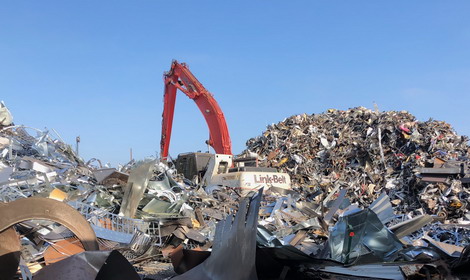
In the global commodities and circular economy logistics landscape, the transpacific trade of ferrous scrap is undergoing a massive structural shift from traditional bulk vessels to containerization. However, handling highly irregular heavy scrap has long been plagued by operational bottlenecks, container damage, and severe safety hazards. This article examines real-world transpacific trade corridors—connecting premier US West Coast export processors with major Electric Arc Furnace (EAF) steel mills across South and Southeast Asia. We deconstruct how the ZFITA Hydraulic Container Tilting Solutions engineered turnkey project eliminates the historical pain points of scrap metal container unloading and loading, helping global enterprises achieve a drastic reduce unloading labor cost, achieve faster container unloading, and maximize their return on investment (ROI).
1. Industry Context: The Critical Pain Points of Transpacific Scrap Containerization
As the world’s foremost powerhouse for high-grade scrap metal generation, the US West Coast feeds global steel manufacturing via critical hubs like the Port of Los Angeles, Port of Long Beach, and Port of Oakland. Industry leaders such as Alco Iron & Metal, Ekco Metals, and Calbag Metals increasingly rely on heavy-tested 20ft shipping containers as their primary logistical vehicle to transport Heavy Melting Scrap (HMS 1/2), Shredded Scrap (ISRI 211), and Plate & Structural (P&S) scrap to Asia.
However, conventional horizontal stuffing and destuffing methods subject this green supply chain to severe technical friction at both the exporter (loading) and buyer (unloading) nodes:
The Exporter's Dilemma: Suboptimal Payload & Container Damage: Relying on material handlers or excavators to horizontally "shove" sharp, irregular scrap into a container inevitably creates massive, unusable void spaces. This prevents the actual payload from reaching the maximum 24–25 metric ton ocean freight limit, inflating per-ton shipping costs. Furthermore, the violent friction between heavy steel and the container's interior walls leads to catastrophic structural damage, triggering steep repair claims from ocean carriers.
The Buyer's Bottleneck: Throughput Deficit & Demurrage Penalties: Once the cargo arrives at the yards of prominent South and Southeast Asian buyers—such as Tata Steel, JSW Steel, or Hoa Phat Group—the scrap metal container unloading phase frequently becomes a financial black hole. Traditional manual raking or blind crane grappling is notoriously slow. It completely fails to deliver a faster container unloading rhythm, causing massive trucking queues, plant congestion, and exorbitant carrier demurrage fees.
The Universal Supply Chain Question: In an era demanding rapid asset rotation, how to unload bulk materials faster while maintaining absolute container unloading safety has become a top-tier priority for global procurement and logistics directors.
2. The Engineering Blueprint: ZFITA's Integrated Bulk Handling System
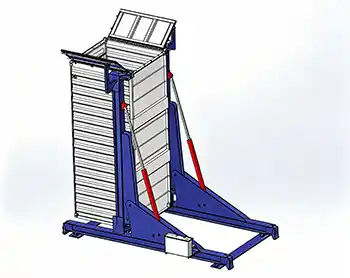
To resolve these cross-border bottlenecks, ZFITA has engineered a comprehensive suite of Container Tipping Solutions powered by industrial-grade heavy-duty hydraulics. This end-to-end framework bridges the efficiency gap between Western scrap processing yards and Asian smelting facilities:
[US West Coast Exporter Yard]                [Ocean Transit: 20ft Heavy Tested]             [Asian EAF Steel Mill Terminal]
       ZFITA 90° Vertical                              Payload Optimized (+20%)                        ZFITA Connected Mobile
   Hydraulic Container Tilter   =======>   [ 25-Ton Sealed Container ]   =======>   Container Tipper / Flipper
 (Gravity-Assisted Dense Packing)          (Zero Structural Box Damage)                    (Complete Discharge in <3 Mins)
Type A: ZFITA Heavy-Duty Hydraulic Container Tilter
A true force-multiplier for the export terminal. Built from high-tensile structural alloy steel and driven by high-displacement, double-acting hydraulic cylinders, this container unloading machine for scrap metal supports precise digital tilting of standard ISO containers from 0° to 90°. By positioning the container vertically, scrap settles uniformly under its own weight, maximizing space utilization and eliminating internal dead zones.
Type B: ZFITA Intelligent Container Tilting Platform
The structural centerpiece of the receiving mill's melt shop. Engineered explicitly for scrap metal container unloading, this heavy-duty container unloading equipment features an automated Hydraulic Twist-Locking System that clamps the container's corner castings with tons of structural securing force. Operating via high-pressure proportional valves, it delivers unmatched stability during high-angle tipping.
Type C: ZFITA Turnkey Bulk Container Unloading Systems
For Tier-1 global steel conglomerates aiming for Industry 4.0 operational standards, ZFITA delivers a complete, automated bulk material unloading solution. This fully integrated, master-engineered system incorporates heavy-duty load-cell weighing modules, a hydraulic spill-proof containment gate, a centralized Human-Machine Interface (HMI) console, and a synchronized dust-suppression system—transforming a historically chaotic process into a clean, digitized, closed-loop operation.
3. Operations Decoded: Cross-Pacific Performance Benchmarks
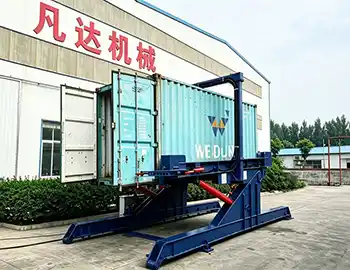
To quantify the engineering impact of the ZFITA system, we examine the comparative operational data from the active processing yard of Alco Iron & Metal in California and the high-output melt shop of Hoa Phat Group in Vietnam.
Origin Port Loading: Vertical Stuffing at Alco Iron & Metal
Previously, stuffing a 20ft heavy container at Alco Iron & Metal’s Oakland facility required two material handlers working in tandem for roughly 50 minutes. Due to material interlocking, the payload rarely exceeded 20 metric tons.
Following the deployment of the ZFITA hydraulic container tilter, empty containers are driven directly onto the container tilting platform and safely erected to an 80° angle. The material handler simply drops the shredded scrap or HMS directly into the top opening.
Stuffing Cycle Time: Drastically reduced from 50 minutes to just 12 minutes.
Average Net Payload: Consistently maximized from 20 tons to 24.5 tons, hitting the sweet spot of ocean freight cost-efficiency.
Box Damage Rate: Zero mechanical contact with the container walls reduced container structural damage to absolute zero.
Destination Discharge: Rapid Gravity Dumping at Hoa Phat Group
When these sealed containers arrive at Hoa Phat Group’s EAF facility, the ZFITA container tipper / flipper infrastructure completely redefines the melt shop's intake capacity.
In the past, discharging a single scrap container required overhead cranes and ground crews manually pulling tangled structural scrap out of the box—a grueling 1.5-hour process fraught with safety risks.
With the ZFITA container tipping solution, the container truck backs directly onto the heavy-duty platform. The operator executes the cycle via a wireless remote control from a safe, enclosed pulpit. The platform tilts smoothly to a 55° angle. As the container door automatically unlatches via hydraulic limiters, 24+ metric tons of heavy scrap discharge seamlessly into the scrap bay in under 150 seconds, demonstrating a highly optimized, fast container unloading system.
4. The Value Matrix: Uncompromising Safety, Efficiency, and Capital ROI
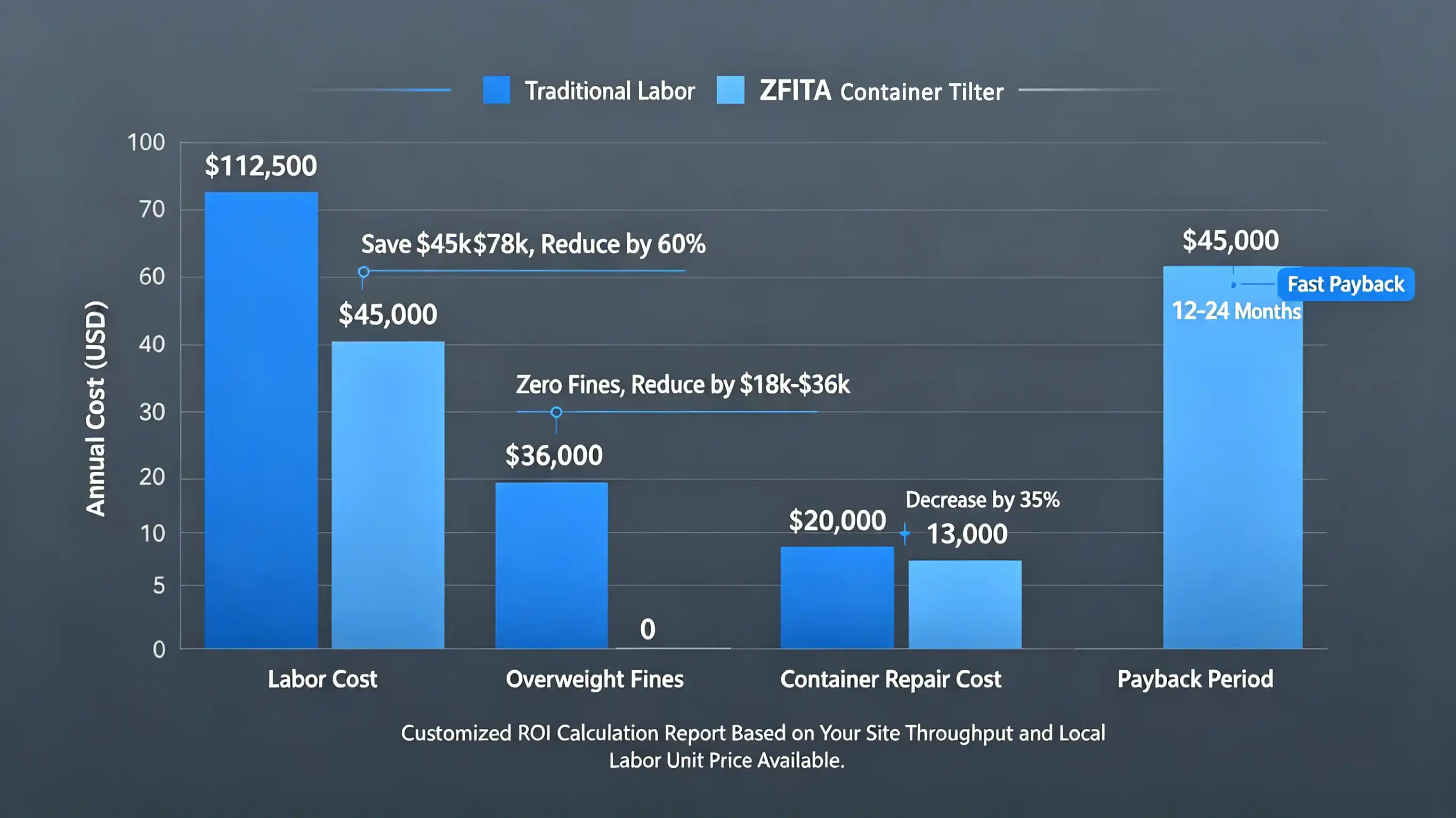
For industrial capital asset buyers, purchasing automated heavy machinery hinges entirely on three core pillars: system safety, operational cost mitigation, and an accelerated payback period.
I. Uncompromising Operational Security (Safe Bulk Unloading)
Working with falling scrap involves absorbing immense, unpredictable dynamic kinetic forces. ZFITA treats container unloading safety as its core engineering principle:
Anti-Rupture Hydraulic Safety Valves: The hydraulic manifold is integrated with mechanical velocity fuses and pilot-operated check valves. In the highly improbable event of a sudden hose rupture or facility power failure, the cylinders lock instantly, freezing the 40-ton loaded container in mid-air to prevent any gravitational free-fall.
Smart Interlocking & Proximity Sensors: The platform features an array of infrared safety light curtains and structural load-cell balance sensors. If a shift in the scrap's center of gravity is detected during a cycle, the system immediately suspends operation, offering a significantly safer truck unloading system than conventional tippers.
II. Drastic Opex and Time Mitigation (Cost & Time Reduction)
Deploying the comprehensive Bulk Container Unloading Systems immediately optimizes a mill’s operational balance sheet:
Reduce Unloading Labor Cost: The entire container handling cycle requires only a single operator or the truck driver utilizing a remote control. The entire ground labor crew previously assigned to hazardous manual cleanouts can be completely eliminated, mitigating worker compensation risks.
Reduce Unloading Time: Shrinking the container turnaround time by over 90% expands a steel mill's intake capacity exponentially. This rapid throughput allows steel mills to completely eliminate demurrage and detention fines resulting from port congestion or delayed container returns.
III. Mathematical ROI Calculation Model
The capital expenditure (CapEx) of a ZFITA system is offset by rapid, predictable operational savings. CFOs can evaluate the acquisition using this verified industrial ROI framework:
According to performance audits conducted across multiple metallurgical plants in South Asia:
Maximizing payloads to 24.5+ tons decreases per-ton ocean freight costs by 15% to 18%.
Achieving a faster container unloading rhythm completely eliminates yard bottleneck charges.
The Verified Bottom Line: A standard ZFITA hydraulic container tilter processing a baseline of 15–20 containers per day achieves full Capital Payback (ROI Return) within 6.5 to 8.2 months, yielding significant net-positive margins over its extensive operational lifespan.
Conclusion
As the global steel sector accelerates its transition toward green, low-carbon EAF steelmaking, the supply chain efficiency of scrap metal directly dictates a mill's margins.
From the high-throughput export docks of the US West Coast to the high-output melt shops of Asia's industrial heartlands, ZFITA bridges the global efficiency gap. By implementing our Hydraulic Container Tilting Solutions, scrap traders and steel producers turn a historical logistical bottleneck into a high-speed, automated competitive advantage.
If you are looking to reduce unloading labor cost, implement a safe bulk unloading architecture, or discover the absolute benchmark on how to unload bulk materials faster, ZFITA is engineered to deliver your custom Bulk Container Unloading Systems. Contact our global bulk materials engineering division today for a comprehensive technical consultation and project whitepaper.
label:
related news



Click to Chat.
Im online now.