
Container Tilter---Solutions for Scrap Metal & Solid Waste Recycling
release time:
2026-06-14
Global recycling industries keep expanding worldwide. Container tilters deliver reliable bulk handling solutions for scrap metal and solid waste operations.
Global Solid Waste & Scrap Metal Recycling Industry Development and Container Tilter Application Solutions
The global scrap metal recycling and solid waste recycling industries have entered a new phase of standardization, automation, and containerized operation. Tightening environmental regulations, rising landfill taxes, and increasing labor costs across most countries have accelerated the upgrading of traditional bulk material handling methods. Conventional manual and grab-bucket unloading methods suffer from low efficiency, high material residue, and severe safety risks, which can no longer meet the operational demands of large-scale recycling facilities. Modern container tilter and container dumper equipment has become standard core machinery for the standardized upgrade of global scrap metal and solid waste recycling projects. With reliable bulk container unloading and bulk container loading performance, 20 ft container tilter and 40 ft container tilter have widely replaced outdated handling solutions. These machines support professional container unloading and container loading workflows for recycling yards, port terminals, and solid waste transfer stations worldwide.
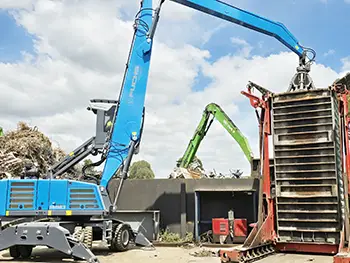
1. Development Trends of the Global Scrap Metal Recycling Industry
The global scrap metal recycling market maintains steady expansion. In 2023, the global scrap metal market revenue reached USD 282.15 billion, with industry forecasts projecting a breakthrough of USD 409.9 billion by 2030, representing a stable CAGR of 5.6%. Driven by global manufacturing recovery, continuous infrastructure investment, and the growing volume of end-of-life vehicles and waste home appliances, the output of scrap steel, scrap aluminum, and appliance shredding residues has increased significantly. This trend promotes the improvement of global recycling infrastructure and makes mechanical and automated handling essential for modern recycling operations.
In terms of regional distribution, North America and Europe represent mature markets, while the Asia-Pacific, Southeast Asia, and the Middle East dominate global growth. Supported by mature circular economy policies, North American countries maintain high metal recycling rates. The United States recycles over 82 million tons of scrap metal annually, with electric arc furnace steelmaking accounting for 70% of total steel production. The strong demand for clean bulk scrap metal handling makes the 40 ft container tilter standard equipment for large recycling enterprises and port terminals, delivering high-efficiency bulk container unloading for massive metal materials.
Australia and New Zealand feature highly standardized and containerized scrap metal logistics. Australia processes more than 15 million tons of scrap steel each year. With strict restrictions on unregulated scrap metal exports and strong policy support for domestic deep processing industries, local facilities adopt a combined configuration of 20 ft container tilter and heavy-duty 40 ft container tilter to handle variable tonnages of scrap metal and appliance shreds. New Zealand’s recycling sector is export-oriented, with over 70% of recycled metal materials transported via containers. Lightweight container tilter units are widely deployed in medium and small recycling yards, effectively eliminating low efficiency and high residue issues associated with traditional unloading methods.
Benefiting from stringent EU environmental standards, European countries including Poland, Germany, and the Netherlands maintain high-standard and large-scale scrap metal recycling systems. As a core EU scrap processing hub, Poland handles over 15 million tons of scrap steel annually. CE-certified container dumper equipment enables standardized container loading and container unloading for inland ports and metal processing plants. Germany and the Netherlands focus on high-end precision recycling, requiring dust-free, explosion-proof, and low-residue handling. Customized premium container tilter units ensure lossless unloading for high-purity scrap metal and appliance shredding materials.
The Asia-Pacific and Southeast Asia regions are the fastest-growing markets for scrap metal recycling. Rapid infrastructure and industrial expansion in India, Vietnam, Malaysia, and Indonesia have created a substantial domestic scrap steel supply gap, resulting in heavy reliance on imported metal scraps. India’s annual scrap steel demand exceeds 40 million tons, driving strong market demand for heavy-duty 40 ft container tilter units. The stable bulk container unloading capability supports high-volume handling at steel mills and port terminals. Vietnam and Malaysia host dense clusters of medium and small recycling yards, where cost-effective and low-maintenance 20 ft container tilter machines are widely adopted for flexible bulk scrap and residual material transportation.
Japan and South Korea represent high-end, refined recycling markets with nearly 100% metal recycling efficiency. Premium recyclables such as automotive aluminum scraps and electronic appliance shreds require precise and clean material handling. Low-noise, dust-free, low-residue precision container tilter units deliver refined bulk container loading and unloading to guarantee material purity and meet strict local environmental and operational standards. Gulf Cooperation Council (GCC) countries generate large volumes of industrial scrap steel, aluminum profiles, and pipeline waste from extensive infrastructure and petroleum industry projects. High-temperature resistant and explosion-proof 40 ft container tilter units are increasingly adopted to adapt to harsh desert working conditions.
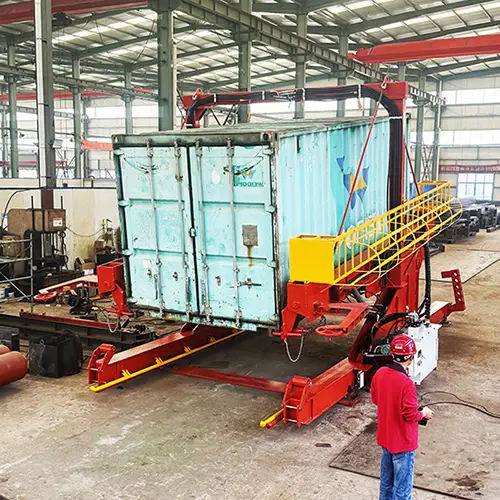
2. Current Status and Regional Characteristics of the Global Solid Waste Recycling Industry
The global solid waste recycling industry has entered a new era of mandatory resource recovery and containerized transportation. Harmless disposal and resource regeneration of industrial residues, construction waste, and municipal solid waste have become core environmental priorities worldwide. Europe achieves an average solid waste recycling rate of over 58%, while the Asia-Pacific region records an annual growth rate of 4.3%. The Middle East and Southeast Asia show the fastest growth in solid waste generation. The mismatch between surging waste volumes and outdated manual handling systems has accelerated the adoption of automated container dumper and container tilter equipment, providing complete bulk container unloading solutions for solid waste transfer, disposal, and resource recovery.
North America features a highly standardized solid waste management system. Skyrocketing landfill taxes in the United States and Canada have phased out conventional bulk transportation, making 40 ft and 53 ft shipping containers the mainstream carriers for solid waste. Fixed heavy-duty container tilter units are widely installed at municipal solid waste transfer stations and construction waste disposal sites. Each operational cycle supports rapid container unloading of domestic waste and construction residues, achieving a throughput of 8 to 10 containers per hour and significantly improving transfer efficiency. Canada imposes strict bans on industrial residue landfilling and enforces full resource recovery. 180-degree turnover container dumper machines are utilized for high-humidity and high-viscosity industrial waste to eliminate material residue and maximize resource utilization rates.
Australia’s solid waste sector prioritizes construction waste recycling and compliant municipal waste disposal. With landfill tariffs ranging from 80 to 150 AUD per ton across Australian states, policies mandate a minimum construction waste recycling rate of 80%. 40 ft container tilter units directly connect container unloading workflows with crushing and sorting production lines, boosting operational efficiency by over three times compared with traditional grab equipment. Construction waste accounts for more than 50% of New Zealand’s total solid waste. The country widely adopts container compression transfer modes, with 20 ft container tilter machines serving small and medium-sized transfer stations for fast unloading of mixed municipal and construction waste.
Europe maintains the world’s most rigorous solid waste regulatory framework. Countries including the United Kingdom, Italy, Spain, Czech Republic, and Hungary continuously raise landfill fees and enforce mandatory waste classification and resource recovery. Industrial and construction solid waste is fully transferred via standardized containers. All solid waste handling equipment operating in the EU must comply with CE certification. Standardized container tilter units are widely applied in waste transfer stations, incineration plants, and residue disposal facilities, supporting high-efficiency bulk container loading and unloading to steadily lift regional recycling rates.
Southeast Asia and India are undergoing rapid solid waste industry upgrading. Accelerated urban construction and industrial expansion have led to a sharp increase in construction waste, industrial slag, and municipal waste, overwhelming traditional manual handling capacity. The rapid construction of recycling plants and transfer stations drives fast penetration of universal20 ft container tilter and 40 ft container tilter equipment. Their cost-effectiveness, simple operation, and low maintenance effectively resolve bulk waste handling bottlenecks and support industry standardization.
Gulf countries adopt high-standard infrastructure for solid waste management. Extremely high labor costs and strict environmental regulations mandate fully enclosed containerized transportation for construction waste, petroleum industrial residues, and municipal solid waste. Customized high-temperature resistant, dust-proof, and explosion-proof container dumper and container tilter units deliver stable bulk container unloading performance and ensure safe, efficient operation under extreme desert working conditions.
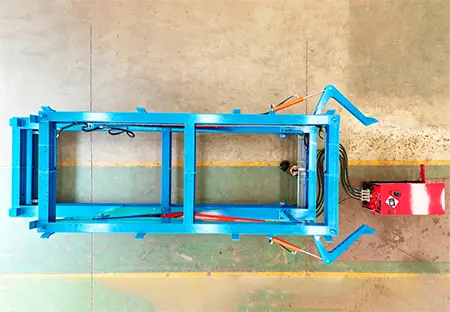
3. Core Application Solutions of Container Tilter Series Equipment
Tailored for global scrap metal recycling and solid waste recycling scenarios, 20 ft container tilter, 40 ft container tilter, and customized container dumper systems form a complete bulk container handling solution. The equipment solves four core industry pain points: low unloading efficiency, high material residue, operational safety hazards, and high labor costs, fully adapting to diverse working conditions across global markets.
In scrap metal recycling applications, the equipment efficiently processes scrap steel, scrap aluminum, automotive shreds, appliance residual materials, and industrial metal slag through automated turnover and tilting workflows, completing full-process bulk container unloading and bulk container loading. Light-duty 20 ft container tilter units suit small and medium-sized recycling yards with limited space and scattered material batches, featuring compact structure and easy operation. Heavy-duty 40 ft container tilter machines provide strong load-bearing capacity for large-scale steel mills and port terminals, achieving a daily processing capacity of 500 to 800 tons to replace high-risk manual and grab handling. High-end container dumper equipment supports 180° and 360° full rotation turnover, eliminating material residue completely and preserving the purity of high-grade recycled metal for premium markets in Europe, America, Japan, and South Korea.
In solid waste disposal applications, the product line covers full-range handling of industrial residues, construction waste, and municipal solid waste. Standard container tilter equipment can be directly docked with crushing lines, sorting systems, and incineration facilities to realize one-click automatic container unloading, supporting large-scale unmanned operation at transfer stations, industrial waste disposal bases, and construction waste recycling plants. For high-viscosity, high-moisture, and residue-prone solid waste, customized container dumper units achieve maximum container emptying through full-turnover operation, reducing material waste and secondary pollution and meeting global green recycling and resource regeneration standards.
All models support customized upgrades to meet regional certification and environmental requirements, including EU CE explosion-proof standards, Japan-Korea low-noise and dust-free specifications, Middle East high-temperature and dust-proof configurations, and Southeast Asia humidity-resistant designs. With reliable professional container unloading and container loading capabilities, the equipment portfolio supports the standardization, intelligence, and high-end upgrading of global metal and solid waste recycling industries, serving as essential core machinery for global circular economy development.
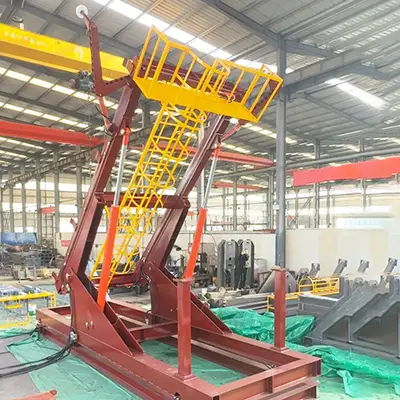
4. Future Development Outlook of Global Recycling Industry and Equipment Application
From 2026 to 2030, the global scrap metal and solid waste recycling industries will maintain sustained and stable growth, with green circulation, resource regeneration, and compliant disposal becoming core industrial development themes. Continuous tightening of environmental policies, rising landfill charges, and increasing labor costs will further popularize containerized bulk material transportation, driving continuous market penetration of automated, intelligent, and customized handling equipment.
In terms of industrial evolution, the global recycling sector will gradually form a closed-loop system featuring large-scale centralized recycling, standardized container logistics, and intelligent automated disposal. Small scattered recycling yards will continue to integrate, while large-scale standardized recycling bases and port logistics terminals will dominate the market, generating sustained demand for high-performance bulk container unloading and intelligent handling equipment. Scrap metal recycling will develop toward high-precision and high-purity regeneration, and solid waste disposal will achieve comprehensive harmlessness and resource utilization, forcing handling equipment to iterate toward zero-residue, dust-free, intelligent, and customized designs.
In terms of equipment upgrading, basic simple tilting machines will be phased out. Standard 20 ft container tilter and 40 ft container tilter will maintain universal market popularity, while 180°/360° full-rotation container dumper and intelligent remote monitoring models will become mainstream configurations in high-end markets. Regionally customized equipment will better adapt to differentiated certification standards and extreme working conditions worldwide. Moving forward, the series will continue to deliver efficient, compliant, and cost-effective container unloading and container loading integrated solutions for the global metal and solid waste recycling industry, empowering high-quality sustainable development of the global circular economy.
label:



Click to Chat.
Im online now.